Srikantharun's Engineering Blog
Technical deep-dives on build systems, toolchains, and cross-platform development
Hosting a Meta Vision LLM on an AMD MI300X with vLLM — and the mllama Bug Nobody Documents
by
Self-hosting a vision-language model on AMD Instinct for AI-assisted testing of a WebXR game — including the Llama 3.2 Vision wall I hit, how I diagnosed it, and the pipeline that came out the other side.
TL;DR
- I set out to self-host Meta Llama 3.2 Vision on a single AMD Instinct MI300X (via AMD Developer Cloud + vLLM) to drive AI-assisted test generation for a WebXR game.
- Text models work great (Llama 3.1 8B served in seconds). But Llama 3.2 Vision (the
mllamaarchitecture) does not load on any current ROCm vLLM image — it crashes withAttributeError: 'MllamaProcessor' object has no attribute '_get_num_multimodal_tokens'. - Root cause: vLLM removed its native
mllamaimplementation (last present in ~v0.6.6), so Llama 3.2 Vision falls back to vLLM’s generic transformers multimodal backend — which calls a processor method thatMllamaProcessornever implements. Reproduced across vLLM 0.11rc / 0.27.1 / 0.34.0 and transformers 4.56 / 5.15 / 5.22. - The fix that actually works today:
Qwen/Qwen2.5-VL-7B-Instruct, which vLLM supports natively on ROCm. Drop-in OpenAI-compatible vision endpoint, ~2.3 s/request, ~71 tok/s, 100% GPU utilization on the MI300X. - The payoff: a capture → feedback → verify → continue pipeline where the vision LLM proposes tests from a screenshot and a deterministic oracle keeps only the true ones — then emits Playwright tests that run in CI with no GPU.
Why a vision LLM for game testing?
I’m building a small WebXR game (Immersive Web SDK / Three.js) — a target-shooting + grab-and-throw scene that runs in the browser and on Meta Quest.
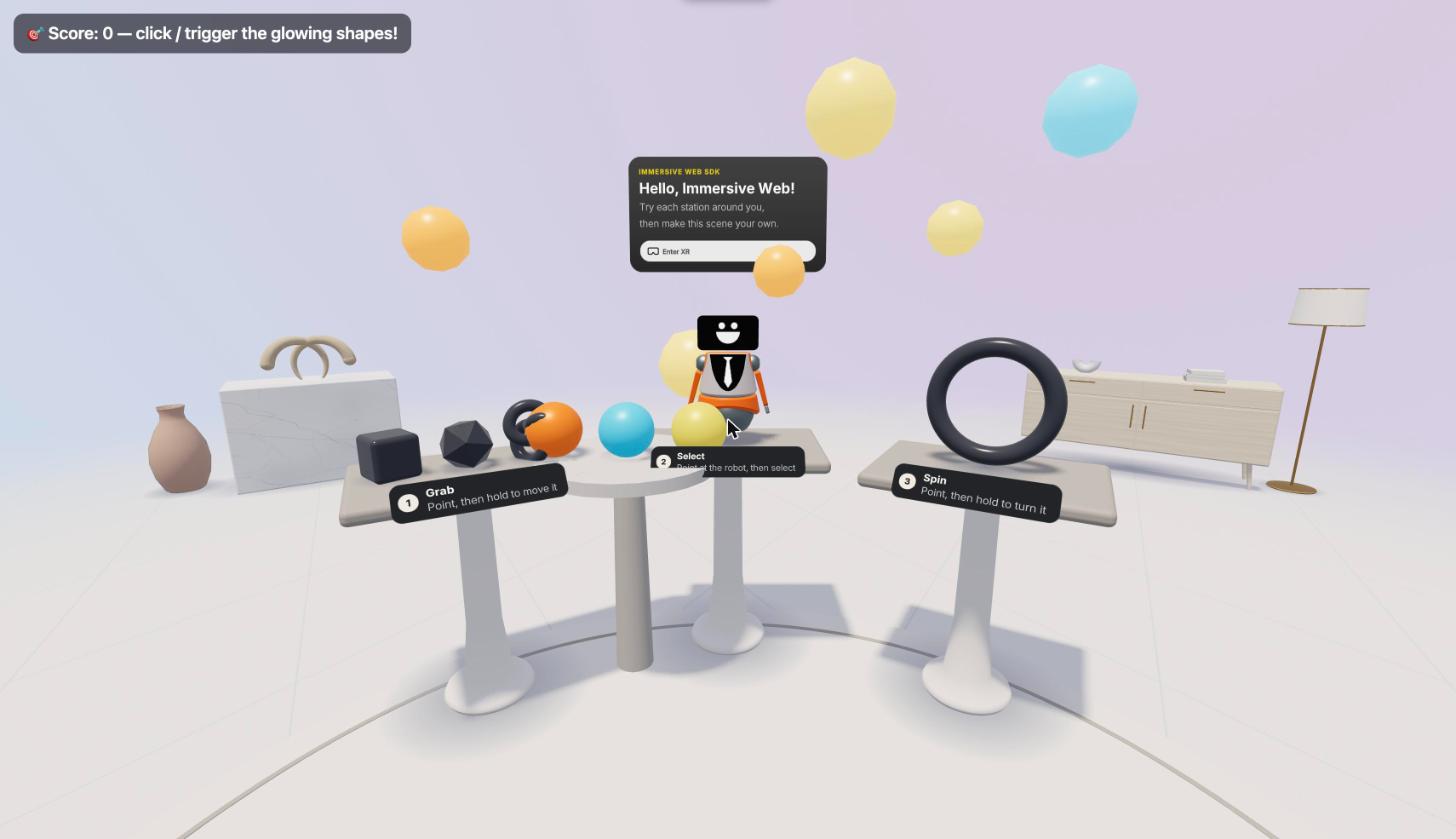
For a game — and especially for anything with user-generated content — you can’t hand-write a test for every scene. The idea: let a vision-language model look at a screenshot and propose test cases, then verify those proposals against ground truth. To keep data private and learn the AMD stack, I wanted the model self-hosted on an MI300X, not a hosted API.
Setup: MI300X + vLLM in a few minutes
On AMD Developer Cloud I spun up a single MI300X GPU Droplet (192 GB HBM3, $1.99/hr) with the vLLM quick-start image, and served a text model to sanity-check the stack:
docker run -d --name vllm \
  --device=/dev/kfd --device=/dev/dri \
  --group-add video --group-add render \
  --ipc=host --shm-size=16g -p 8001:8000 \
  -v ~/.cache/huggingface:/root/.cache/huggingface \
  vllm/vllm-openai-rocm:v0.27.1 \
  --model NousResearch/Meta-Llama-3.1-8B-Instruct \
  --served-model-name llama-3.1-8b \
  --host 0.0.0.0 --port 8000 --api-key "$KEY" --max-model-len 8192
GET /v1/models and a chat completion came back in seconds. rocm-smi confirmed the MI300X was doing the work. So far, textbook.
The wall: Llama 3.2 Vision won’t load
Swapping the model to Meta’s multimodal Llama 3.2 Vision:
--model unsloth/Llama-3.2-11B-Vision-Instruct # mllama architecture
…crashes on startup, every time:
AttributeError: 'MllamaProcessor' object has no attribute '_get_num_multimodal_tokens'
  File ".../vllm/model_executor/models/transformers/multimodal.py", line 208, in _get_num_mm_tokens
    return processor._get_num_multimodal_tokens(**sizes, **mm_processor_kwargs)
This is not a config problem. I reproduced it across a matrix of versions:
| vLLM | transformers | Native mllama? |
MllamaProcessor._get_num_multimodal_tokens? |
Result |
|---|---|---|---|---|
| 0.11.0rc | 4.56.2 | ❌ | ❌ | crash |
| 0.27.1 | 5.15.0 | ❌ | ❌ | crash |
| 0.34.0 | 5.22.0 | ❌ | ❌ | crash |
Two independent facts combine into the bug:
- vLLM no longer ships a native
MllamaForConditionalGeneration.ModelRegistry.get_supported_archs()doesn’t contain it on any current build (native mllama was last present around vLLM v0.6.6, before the switch to the generic transformers backend). So Llama 3.2 Vision is routed through vLLM’s generic transformers multimodal path. - That path calls
processor._get_num_multimodal_tokens(...), whichMllamaProcessornever implements — not in transformers 4.56, 5.15, or 5.22. (You can confirm straight from upstream: the mllama processor source has no such method.)
So the generic backend assumes an interface mllama’s processor doesn’t satisfy, and vLLM has no native path to fall back to. Llama 3.2 Vision is effectively unsupported on current vLLM + ROCm. A one-line monkeypatch returning a dummy token count lets it load but produces wrong accounting — not something to ship.
The pivot that works: Qwen2.5-VL on ROCm
Since Meta’s mllama is a dead end here, the pragmatic move is a vision model vLLM supports natively on ROCm. Qwen/Qwen2.5-VL-7B-Instruct does, cleanly:
docker run -d --name vllm \
  --device=/dev/kfd --device=/dev/dri \
  --group-add "$(getent group video|cut -d: -f3)" \
  --group-add "$(getent group render|cut -d: -f3)" \
  --ipc=host --shm-size=16g -p 8001:8000 \
  -v ~/.cache/huggingface:/root/.cache/huggingface \
  vllm/vllm-openai-rocm:latest \
  --model Qwen/Qwen2.5-VL-7B-Instruct \
  --served-model-name qwen2.5-vl \
  --host 0.0.0.0 --port 8000 --api-key "$KEY" \
  --trust-remote-code --enforce-eager \
  --max-model-len 16384 --gpu-memory-utilization 0.90
Gotcha: the newer image has no named
rendergroup, so--group-add renderfails — pass the numeric GID instead.
It came up healthy in ~125 s and serves an OpenAI-compatible /v1/chat/completions that accepts images as base64 image_url.
Performance on the MI300X
Sending a game screenshot (≈1,593 vision tokens) + a 160-token completion, measured end-to-end (including ATL1→client network):
| Metric | Value |
|---|---|
| Avg latency / image request | 2.27 s |
| Throughput | ~71 completion tok/s |
| GPU utilization (idle → inference) | 0% → 100% |
| Power draw | 233 W |
| VRAM in use | ~173 GB / 192 GB |
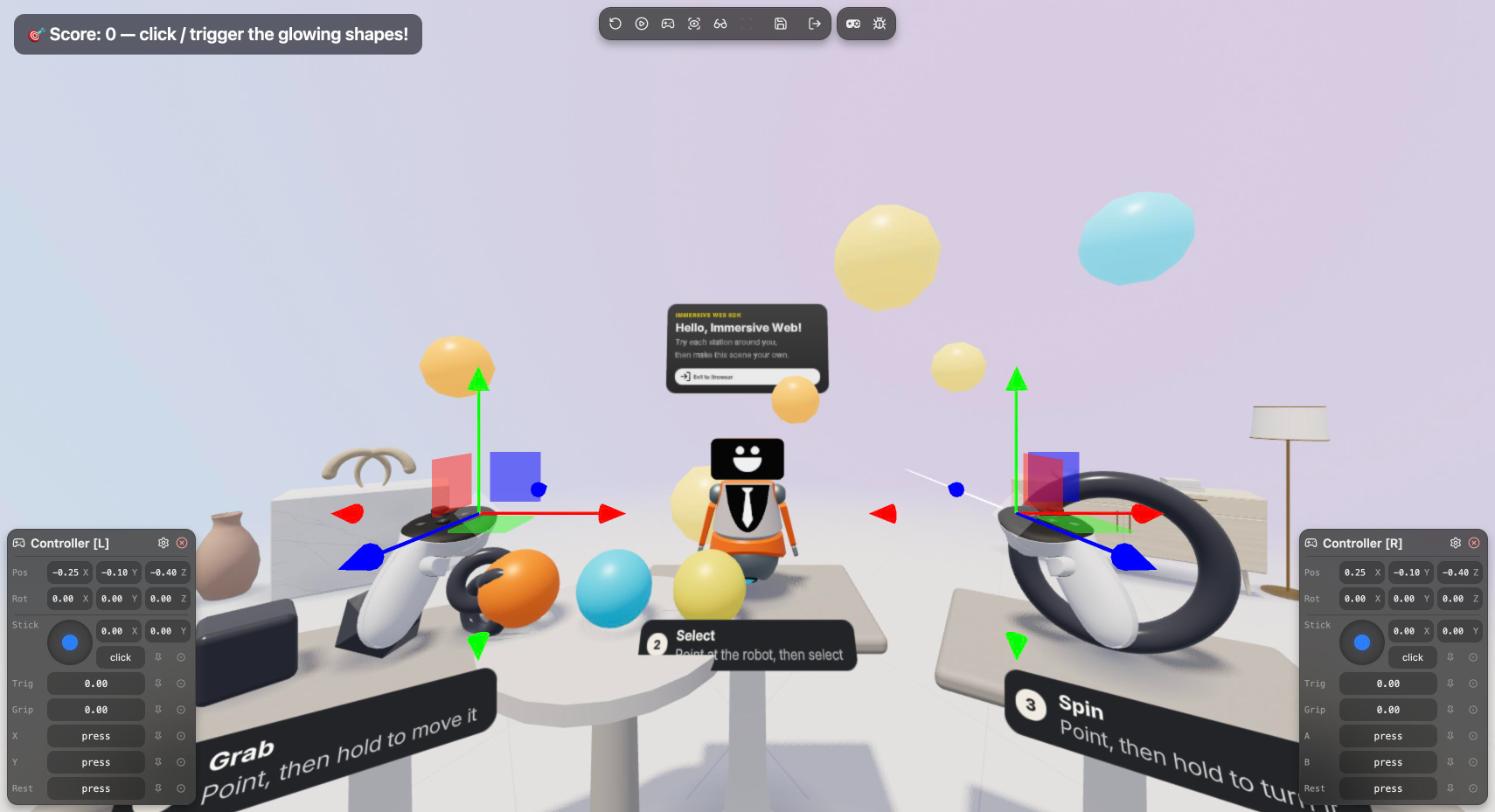
The model saw the scene correctly — HUD text, the floating targets, the three interaction stations, and in the XR/emulator view, the controller gizmos:
The real payoff: capture → feedback → verify → continue
A vision LLM that looks at a screenshot and lists test cases is nice. But its suggestions are hypotheses, not tests — it will also confidently propose things that are wrong. The value is in closing the loop:
1. CAPTURE   Playwright drives the game → screenshot + ground-truth scene metrics
2. FEEDBACK  screenshot → Qwen2.5-VL (MI300X) → structured JSON test candidates
3. VERIFY    each candidate checked against the deterministic oracle → PASS/FAIL
4. CONTINUE  FAILs fed back to the LLM → REAL_BUG vs BAD_SUGGESTION; PASSes promoted
The game exposes a tiny test hook so the oracle is deterministic:
window.__GAME__ = {
  counts() {
    let targets = 0, balls = 0;
    world.scene.traverse(o => { if (o.name === 'target') targets++; else if (o.name === 'ball') balls++; });
    const m = document.getElementById('score-hud')?.textContent?.match(/Score:\s*(\d+)/);
    return { targets, balls, score: m ? +m[1] : null };
  },
};
A real run (ground truth: targets:6, balls:3, score:0):
3. VERIFY   [PASS] targets > 5          (actual 6)
3. VERIFY   [PASS] balls == 3           (actual 3)
3. VERIFY   [PASS] score == 0           (actual 0)
3. VERIFY   [FAIL] targets == 4         (actual 6)
4. CONTINUE targets==4 → BAD_SUGGESTION ("actual is 6")
3. VERIFY   [FAIL] balls == 5           (actual 3)
4. CONTINUE balls==5  → BAD_SUGGESTION ("actual is 3")
→ 7 raw passes → hardened to 3 exact, deduped tests
The loop caught the hallucinations and kept only verified invariants. The pipeline then hardens the loose bounds (targets>5, targets>2, …) into one exact assertion per metric and generates a Playwright spec:
test("targets === 6", async ({ page }) => {
  await gotoGame(page);
  const actual = await page.evaluate(() => window.__GAME__.counts().targets);
  expect(actual).toBe(6);
});
Which runs deterministically in CI — with no GPU:
✓ targets === 6 ✓ balls === 3 ✓ score === 0 3 passed (27.8s)
Takeaways
- Llama 3.2 Vision (mllama) is currently a dead end on vLLM + ROCm. If you need Meta multimodal today, budget for it — or use a natively-supported VLM like Qwen2.5-VL. (Verify with a one-line registry/processor check before pulling a 20 GB image: is
MllamaForConditionalGenerationinModelRegistry.get_supported_archs(), and doesMllamaProcessorhave_get_num_multimodal_tokens? If both are “no,” it won’t load.) - Use the GPU where it’s worth it. The MI300X earns its keep at two steps — generating candidate tests and judging the hard-to-codify semantic/visual stuff. The standing CI suite is deterministic and GPU-free.
- LLM proposes, oracle disposes. Never let the generator be its own only judge. A deterministic ground-truth oracle + a feedback step is what separates real tests from plausible nonsense.
- This is the pattern for UGC/AR/VR. You can’t hand-write assertions for infinite user scenes; you can let a vision model propose coverage per scene and keep only what verifies.
Reproduce
- Quick “will it even load?” check for any VLM on your vLLM image:
docker run --rm --entrypoint python3 <image> -c \ "from vllm.model_executor.models.registry import ModelRegistry as R; \ print('native:', 'MllamaForConditionalGeneration' in R.get_supported_archs())" - Serve Qwen2.5-VL: see the
docker runabove. - The testing pipeline and generated Playwright spec:
pipeline.mjs→verified-tests.json→tests/generated.spec.ts.
Hardware: AMD Instinct MI300X (192 GB) on AMD Developer Cloud. Software: vLLM on ROCm, Qwen2.5-VL-7B-Instruct, Playwright.